Interest
What interest is, how banks connect savers and borrowers, and why compound interest matters over time.
Interest is the cost of borrowing money and the reward for saving it.
If you borrow money, you usually pay interest.
If you save money, you usually receive interest.
Although these seem like two different ideas, they are actually two sides of the same system.
Once you understand how interest works, it becomes much easier to understand bank accounts, borrowing and many other areas of personal finance.
Imagine lending £100 to a friend
Suppose a friend asks to borrow £100 for one year.
You agree.
A year later they return £105.
The extra £5 is the interest.
From your friend’s perspective, paying £5 was the cost of being able to use the money for a year.
From your perspective, receiving £5 was the reward for lending your money instead of keeping it yourself.
This simple example explains why interest exists.
It rewards people for lending money and allows borrowers to access money before they have it themselves.
In everyday life, however, we don’t usually lend money directly to friends or strangers. Instead, banks connect millions of savers and borrowers every day.
How do banks fit in?
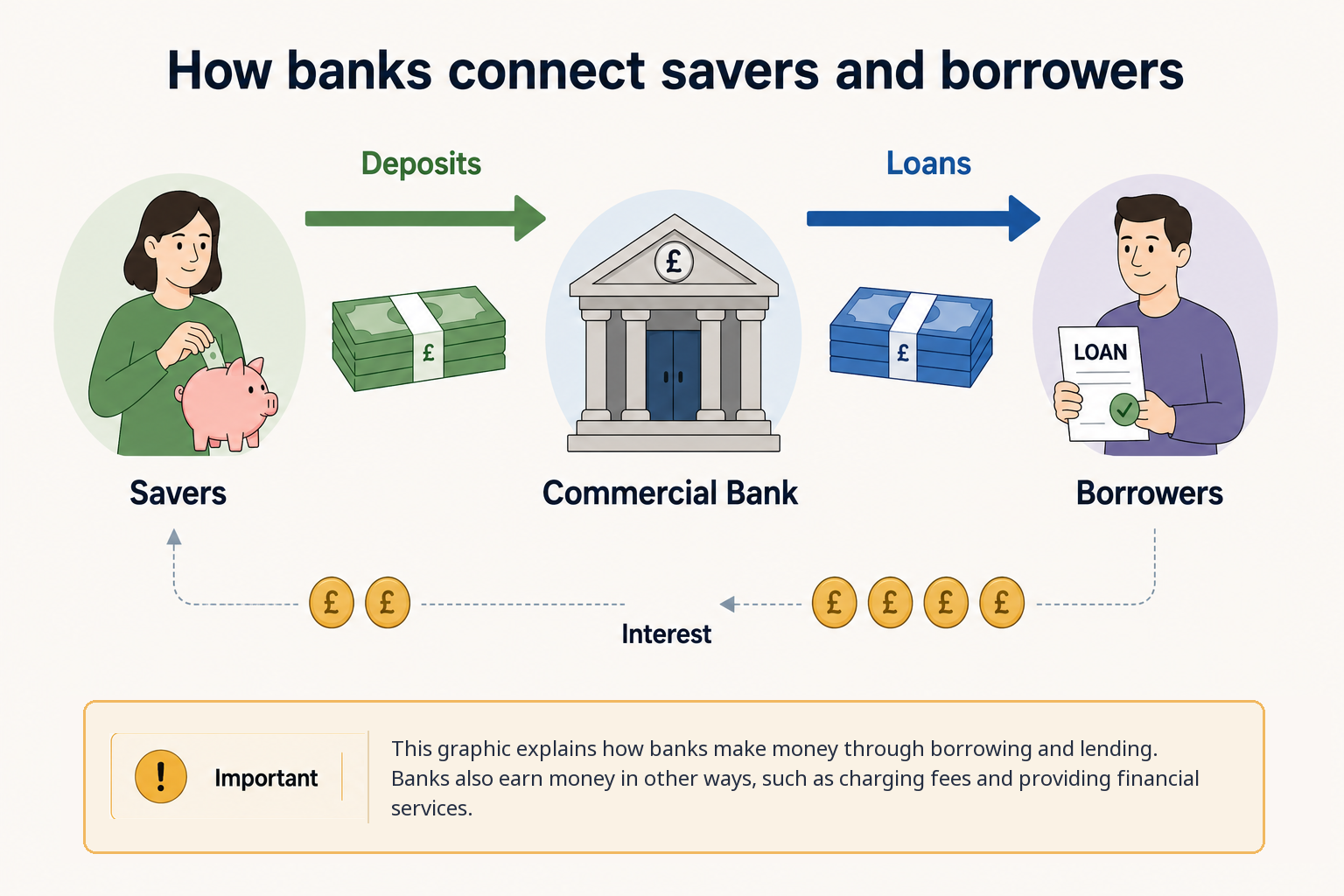
Banks sit between savers and borrowers.
People who have spare money deposit it into savings accounts.
The bank then lends that money to households and businesses that need to borrow it — for example to buy a home, invest in a business or pay for a large purchase.
The bank pays interest to savers.
The bank charges interest to borrowers.
It usually charges borrowers a higher rate than it pays savers. The difference helps pay for staff, technology, fraud protection and the risk that some borrowers do not repay their loans. It also allows the bank to make a profit.
What is the base rate?
The Bank of England sets an official interest rate known as the base rate (officially called the Bank Rate).
Commercial banks keep money at the Bank of England and can also borrow money through it.
The base rate strongly influences what it costs banks to obtain money.
Because this affects banks’ own costs, they use it as the starting point when deciding what interest rates to offer on mortgages, loans and savings accounts.
Banks still compete with one another, so they do not all offer exactly the same interest rates.
However, when the base rate changes, interest rates on mortgages, loans and savings accounts usually move in the same direction.
What is compound interest?
Compound interest means that you earn interest not only on your original savings, but also on the interest you have already earned.
Imagine you save £1,000 in an account paying 5% interest each year.
After the first year: £1,000 → £1,050.
After the second year, you do not earn interest only on the original £1,000.
You also earn interest on the £50 of interest you earned during the first year.
Your savings therefore grow to £1,102.50.
Each year, your savings earn interest on an increasingly larger balance.
Over many years, this can make a surprisingly large difference.
How compound interest grows your money over time
- Compound interest£4,322
- Interest without compounding (not real)£2,500
- Under the mattress£1,000
Although your savings may be growing, inflation also reduces what your money can buy.
If your savings earn 5% interest while inflation is 2%, your spending power is increasing by roughly 3% a year.
This is one reason why earning interest is important. Money kept as cash under the mattress does not grow at all, so inflation gradually reduces its spending power.
Key takeaway
Interest is the cost of borrowing money and the reward for saving it.
Borrowers pay interest because they can use money now instead of waiting until they have it.
Savers receive interest because they allow banks to use their money.
Banks connect the two by moving money from savers to borrowers and earning a profit for providing that service.
Once you understand how interest works, it becomes much easier to understand bank accounts, borrowing and many other areas of personal finance.