Bank Accounts
How current accounts, savings accounts, overdrafts and modern digital banks fit together.
Current accounts vs savings accounts
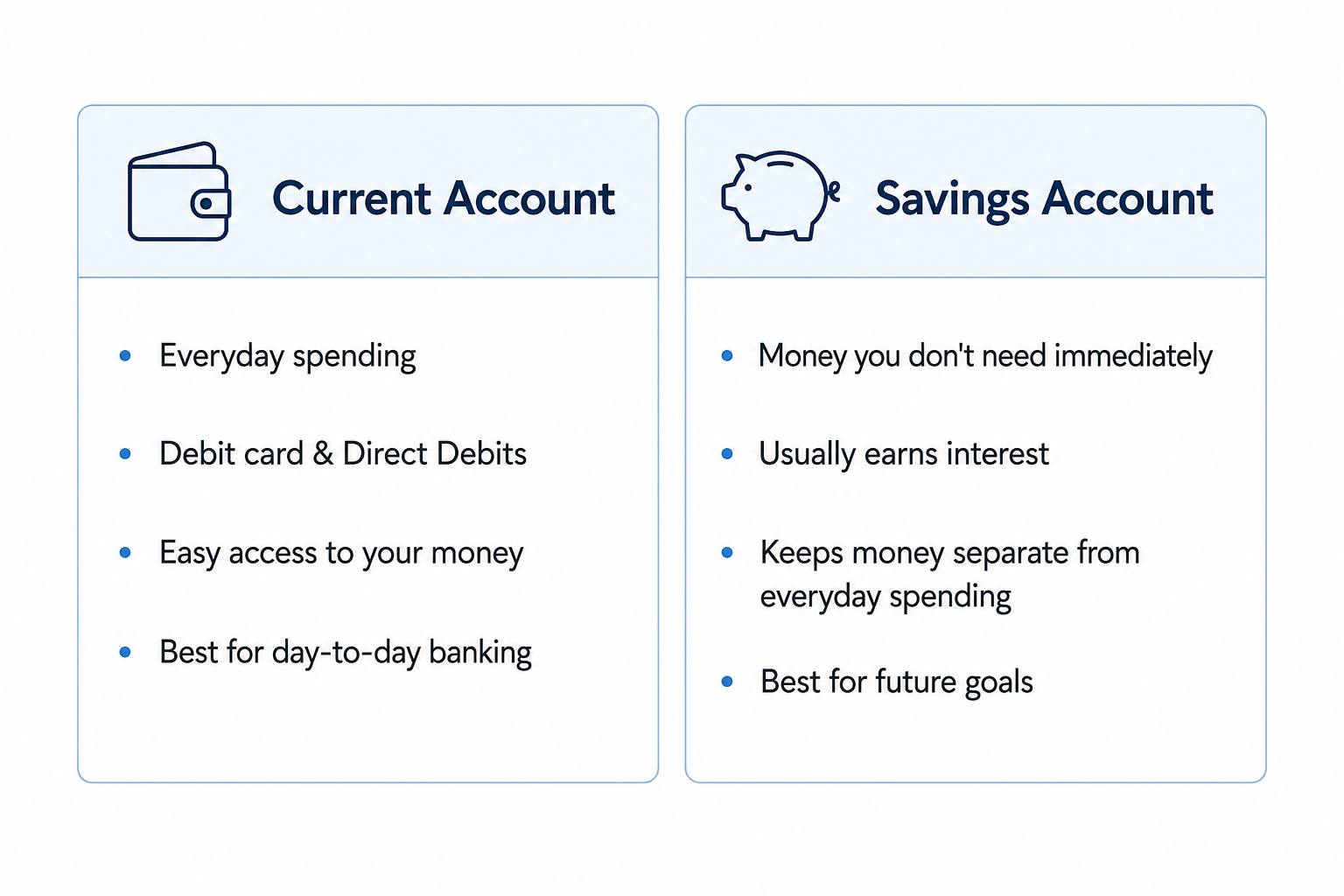
Most people use both a current account and a savings account, but they are designed for different purposes.
A current account is for managing your everyday money. It’s where your salary is usually paid, your bills are collected from, and your day-to-day spending takes place.
A savings account is designed for money that you don't need to spend immediately. Instead of sitting in your current account, this money can usually earn interest while remaining available when you need it.
Rather than choosing one or the other, most people benefit from using both together.
Traditional banks vs digital banks
Both traditional banks and digital banks offer current accounts, savings accounts and many of the same core banking services.
There are two main differences between them.
The first is the range of financial products they offer. Traditional banks often provide a much wider range of services, such as mortgages, loans, credit cards and insurance. We’ll explore some of these products in later articles.
The second difference is how you manage your money, and this is where digital banks have changed the way many people bank.
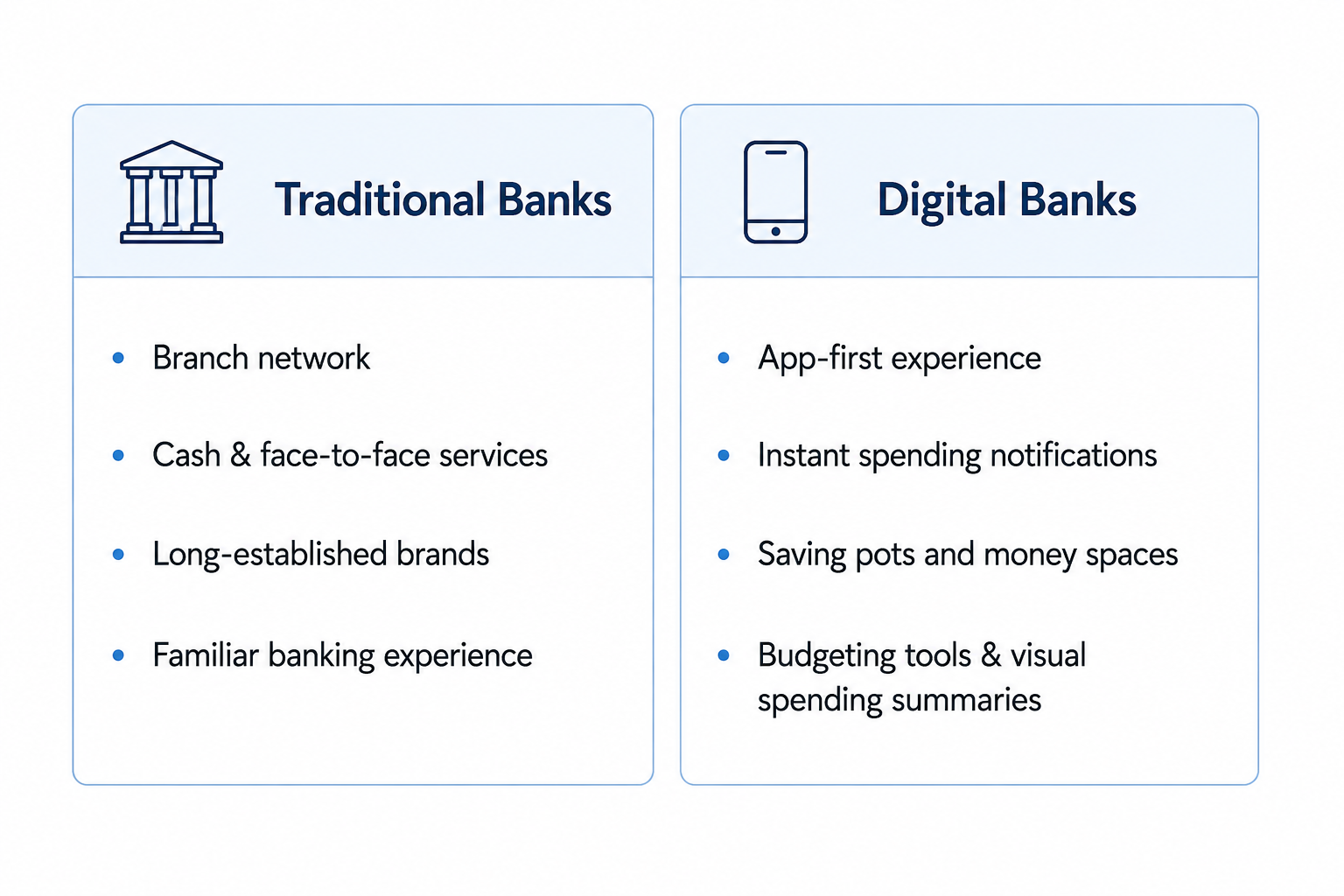
Traditional banks have spent decades building branch networks and face-to-face services. Many people still value being able to visit a branch, pay in cash or speak to someone in person.
Digital banks focus on making everyday money management as simple as possible through their mobile apps.
Digital banks often include features such as:
- Savings pots that can be created or removed in seconds, making it easy to set money aside for emergencies, holidays or other goals.
- Automatic spending categories, where purchases are grouped into categories such as groceries, transport or eating out, helping you understand where your money is actually going.
- Real-time spending notifications, so you know immediately whenever money leaves your account.
- Budgeting tools and visual spending summaries that help you review your spending over time, identify patterns and spot areas where you may be able to save money.
Many traditional banks have introduced similar features in recent years, but digital banks have generally led the way in making day-to-day money management and budgeting simple and intuitive.
Many people find these features make it easier to separate money for different purposes, such as household bills, an emergency fund or a holiday. This can help you see how much money is genuinely available to spend and reduce the temptation to accidentally spend money that has already been set aside.
What is an overdraft?
An overdraft allows you to spend more money than you have in your current account (when your balance goes below zero).
In effect, the bank is lending you money until you pay it back.
As explained in the interest article, borrowing money usually means paying interest, and overdrafts are no exception.
Some overdrafts are interest-free up to an agreed limit, but many charge relatively high interest rates or fees. Compared with many other forms of borrowing, overdrafts can be an expensive way to borrow money, particularly if you rely on them regularly.
An overdraft can be useful if you experience a short-term cash-flow problem, but relying on one regularly suggests that your spending is exceeding your income.
If you find yourself using an overdraft frequently, reviewing your budget or considering cheaper forms of borrowing may be a better long-term solution.
Is my money safe?
Banks are among the most heavily regulated financial institutions in most developed countries.
Many countries also operate deposit protection schemes that protect customers if a regulated bank fails. The rules and protection limits vary between countries, but the aim is the same: to protect ordinary savers from losing their money if a bank becomes insolvent.
In the UK, eligible deposits are currently protected up to a specified limit per person, per authorised bank under the Financial Services Compensation Scheme (FSCS) (opens in a new tab).
If you live outside the UK, your country is likely to operate a similar scheme, although the level of protection and eligibility rules may differ.
Key takeaway
A current account is for everyday spending, while a savings account is for money you want to keep for the future.
Choosing a bank with tools that help you manage your money can make budgeting and saving much easier.
Remember that an overdraft is a form of borrowing, and borrowing usually comes at a cost.