Inflation
What inflation is, why prices rise, and why central banks aim for it to stay low and steady.
What is inflation?
Inflation is the general increase in prices over time.
If inflation is 3% a year, something that costs £100 today would cost around £103 a year later.
Not every price changes by the same amount. Some prices rise quickly, some rise slowly, some stay the same and a few even fall. Inflation is simply a measure of the average change in prices across the economy. It brings all of these price changes together into a single average figure.
Why do prices go up?
At its simplest, prices change because the balance between supply and demand changes.
If more people want to buy something than businesses can produce, prices tend to rise.
If businesses produce more than people want to buy, prices tend to fall.
This happens every day for individual products and services. Inflation occurs when price rises become widespread across much of the economy.
What causes inflation?
Almost all inflation can be traced back to changes in supply and demand. These changes usually happen in one or more of the following ways.
Demand increases
If households, businesses and governments all spend more money, demand for products and services increases.
If supply cannot keep up, businesses often raise prices.
For example, if millions of people suddenly decide to renovate their homes, builders may struggle to meet demand. Labour and materials become harder to find, allowing prices to rise.
Supply falls
Sometimes businesses simply cannot produce enough.
Poor harvests, wars, natural disasters, energy shortages and disruption to global supply chains can all reduce supply.
When fewer products are available but demand remains similar, prices usually rise.
During the COVID-19 pandemic, many factories temporarily closed while shipping became much more difficult. This contributed to higher prices for many everyday products.
Business costs increase
Businesses face costs such as wages, electricity, rent and raw materials.
These costs often increase because the businesses supplying them are also affected by changes in supply and demand. For example, wages may rise because employers are competing for scarce workers, while electricity prices may increase if fuel supplies become more limited.
If businesses face significantly higher costs, they often increase their own prices to remain profitable.
For example, if the cost of electricity doubles, a bakery may need to charge more for bread simply to cover its higher running costs.
Annual UK inflation rate, 1976–2025
- Late 1970s / early 1980s: Oil shortages and strong demand pushed prices up sharply
- 1990: Strong demand and rapid borrowing pushed inflation higher
- 2009: Demand fell during the financial crisis, causing prices to fall briefly
- 2022: Strong demand after the pandemic and soaring energy prices caused inflation to surge
Why does inflation matter?
Inflation affects almost everyone because it changes what your money can buy.
If prices rise faster than your income, your standard of living falls because your money buys fewer products and services than before.
If your income rises faster than inflation, your purchasing power increases because your money can buy more than it could previously.
This is why inflation matters to households, businesses and governments alike.
Does lower inflation mean prices are falling?
No.
Lower inflation simply means prices are rising more slowly than before.
For prices to fall across the economy, inflation would need to become negative, which is known as deflation.
This is why people may still feel worse off even after inflation has “come back down”. If prices rose sharply over several years but wages did not keep pace, the higher prices remain. Lower inflation does not reverse those earlier increases — it simply slows the rate at which prices continue to rise.
Is inflation always bad?
Not necessarily.
Most national central banks, such as the Bank of England in the UK and the Federal Reserve in the United States, aim for low and stable inflation, rather than no inflation at all.
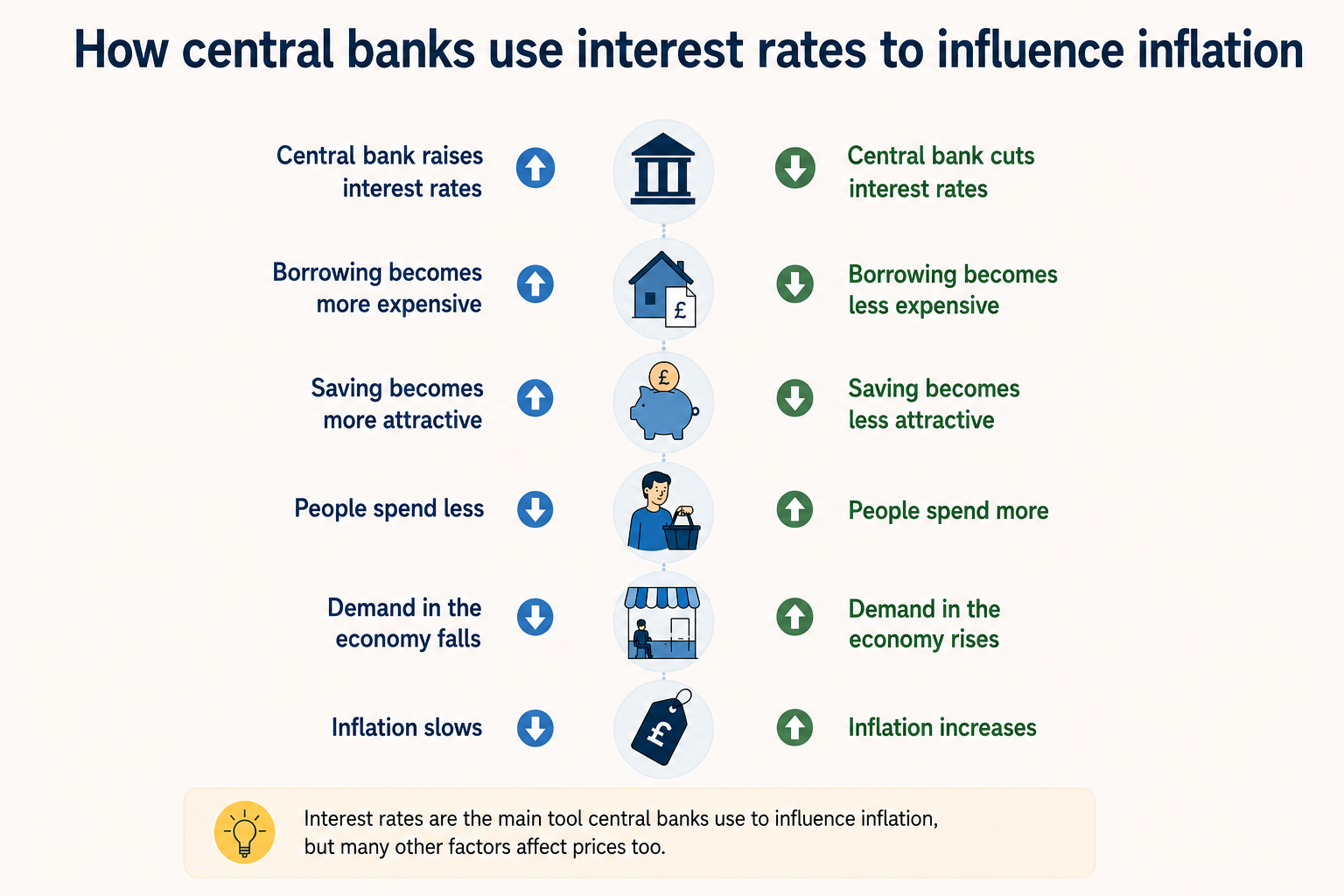
They cannot control prices directly. Instead, they mainly influence inflation by changing interest rates.
Higher interest rates make borrowing more expensive and saving more attractive. This usually reduces spending, slowing demand and easing inflation.
Lower interest rates have the opposite effect. They encourage borrowing and spending, helping demand to increase when inflation is too low.
A small amount of inflation also encourages people and businesses to put money to work. For example, if prices are expected to rise by around 2% each year, keeping large amounts of cash means its spending power gradually falls. People are therefore more likely to save, invest or spend their money productively instead.
High or unpredictable inflation is different. It makes financial planning much more difficult because households and businesses cannot be confident what things will cost in the future. Families may find essential expenses such as food and energy becoming increasingly unaffordable, while businesses may delay investing or hiring because their future costs and customers’ spending are more uncertain. It also reduces the spending power of savings more quickly.
Why is inflation more common than deflation?
Although prices sometimes fall, long periods of deflation are relatively rare.
There are several reasons for this.
- Economies usually grow over time. As businesses produce more, people earn more and spending increases, demand tends to grow alongside the economy.
- Populations often increase. More people means greater demand for homes, food, transport and other products and services.
- People’s incomes generally rise over time. Higher incomes allow households to spend more, increasing demand across the economy.
- Governments and central banks actively try to avoid deflation. Falling prices can discourage spending and investment, making recessions worse, so policymakers usually act to keep inflation slightly above zero.
For these reasons, most developed economies aim for low, stable inflation of around 2%, rather than zero inflation or falling prices.
Key takeaway
Inflation is the average increase in prices across the economy over time.
At its heart, inflation happens because supply and demand become unbalanced across many products and services. Sometimes demand increases, sometimes supply falls, and sometimes businesses face higher costs because of changes in supply and demand elsewhere in the economy.
The important question is not simply whether prices are rising, but whether your income is rising fast enough to keep up.
Understanding inflation also helps explain the next important concept in personal finance: interest. While inflation tells us how quickly prices are changing, interest explains how central banks try to influence inflation and how the value of savings and borrowing changes over time.