Money
What money is, why we use it, and where its value actually comes from.
What is money?
Money is something that people use to buy products and services.
Today, money usually exists as notes, coins and electronic balances in bank accounts. In the past, many other things have been used as money, including shells, salt and precious metals.
Although money comes in different forms, its purpose has always been the same: to make trade easier.
Why do we use money?
Before money existed, people often exchanged products directly. This is known as bartering.
Imagine you grow wheat but need a new axe.
You would have to find a blacksmith who not only makes axes, but also wants wheat.
If the blacksmith wanted eggs instead, you would first have to find someone willing to swap eggs for your wheat.
Finding the right chain of trades could be slow and difficult.
Money solves this problem.
Instead of swapping products directly, you can sell what you have for money and then use that money to buy whatever you need from someone else.
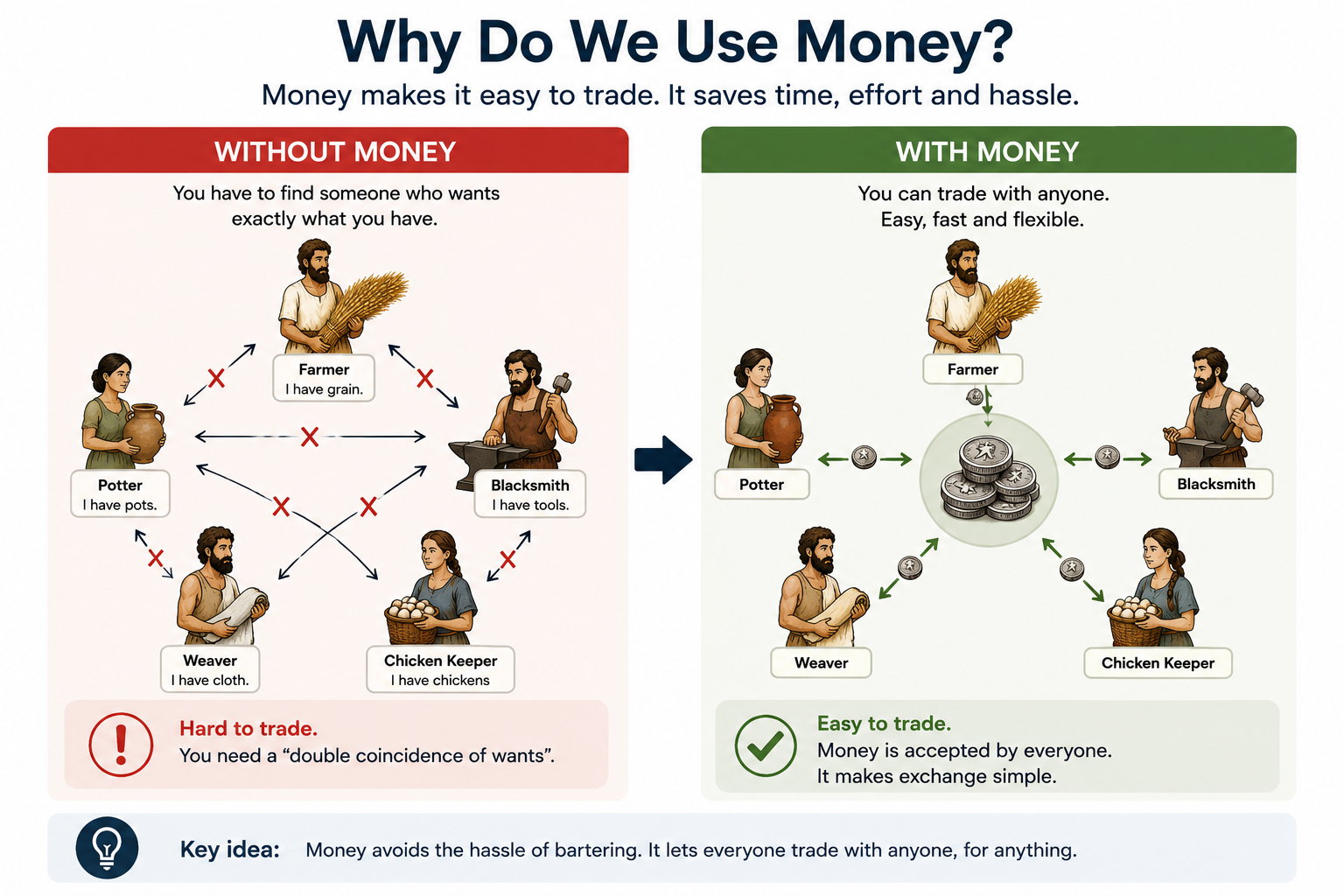
Money makes trade faster, easier and far more flexible. It allows millions of people to buy and sell products and services every day without needing to find someone who wants exactly what they have.
Why does money have value?
Money only works if other people are willing to accept it.
Imagine someone offered you a £20 note, but nobody else would accept it in exchange for products or services.
That note would be worthless.
Money has value because millions of people trust that other people will accept it in exchange for products and services.
That shared confidence allows money to act as a store of value and a way of exchanging products and services across the entire economy.
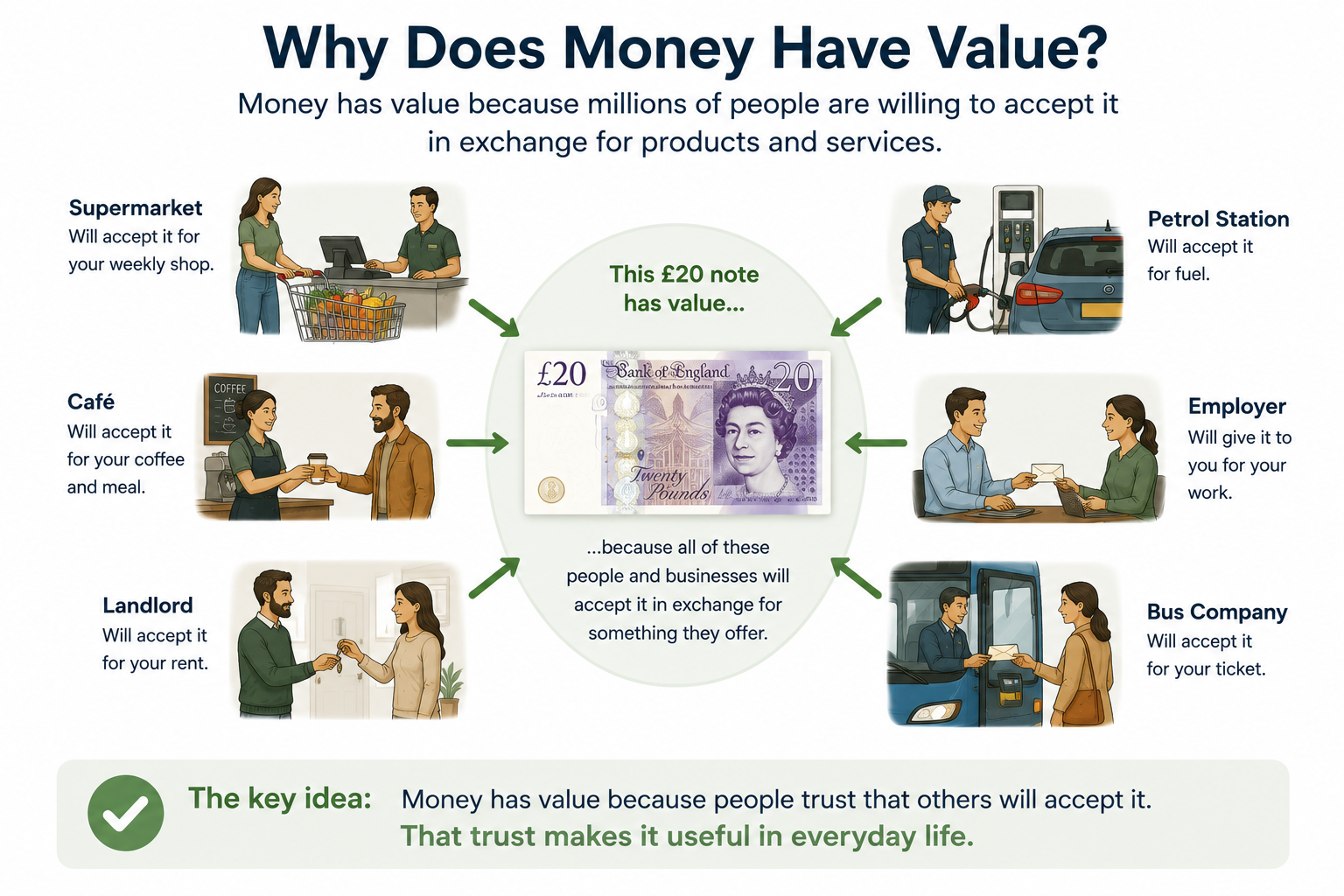
Notice that the value does not come from the paper or the plastic itself.
It comes from the fact that millions of people, businesses and governments are willing to accept it every day.
Why does money matter?
Modern economies would be almost impossible without money.
It allows people to specialise in different jobs, trade efficiently and buy products and services from almost anyone.
Without money, buying everyday things would be far slower, more complicated and much less efficient.
Key points
- Money is something we use to buy products and services.
- Money exists because it makes trade much easier than bartering.
- Money has value because millions of people are willing to accept it.
- Modern economies depend on money to allow people and businesses to trade efficiently.